Discover our primary lineup of custom-engineered corrugated boxes, biodegradable containers, and customized packaging options certified for international safety guidelines.

An authoritative analysis of food-contact corrugated packaging standards, global material sourcing dynamics, and manufacturing technology paradigms for 2025.
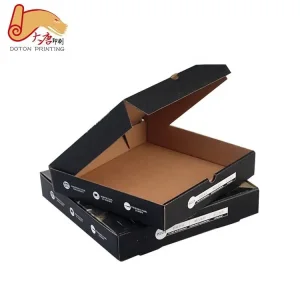
The quick-service restaurant (QSR) sector, particularly the global pizza market, has transitioned from conventional packaging solutions to highly engineered, bio-based alternatives. Corrugated cardboard pizza boxes represent the backbone of this logistics chain, guaranteeing structural integrity, heat preservation, and moisture regulation during transit. The international market demands packaging that complies with strict direct food-contact regulations, making the CE Certification (conforming to Regulation EC No 1935/2004 and EN 13430 standards) mandatory for European imports.
Industrial manufacturers are continuously optimizing the structural matrix of corrugated board. Corrugated packaging utilizes a three-dimensional wavy fluting medium sandwiched between flat linerboards. For pizza boxes, manufacturers typically employ E-flute (approximately 1.6mm thickness) and B-flute (approximately 3.2mm thickness) configurations. E-flute provides a highly dense fluting structure that delivers exceptional crush resistance and a smoother surface for high-resolution graphics printing. B-flute, on the other hand, provides enhanced thermal insulation, keeping pizzas warm over longer courier routes.
Direct food contact requires rigorous material sourcing. Recycled pulp and virgin kraft liners are chemically monitored to prevent the migration of mineral oils (MOSH/MOAH), heavy metals, and fluorinated chemicals (PFAS). CE Certification validates that the packaging elements do not transfer their constituents to food in quantities that could endanger human health.
| Flute Category | Wall Thickness (mm) | ECT Rating (Edge Crush Test) | Thermal Insulation Index | Ideal Application Scenario |
|---|---|---|---|---|
| E-Flute (Micro-Flute) | 1.5 – 1.8 | 4.5 – 6.2 kN/m | Medium | High-End Branded Packaging, Multi-color Offset Graphic Print |
| B-Flute (Standard) | 3.0 – 3.5 | 5.5 – 7.8 kN/m | High | Heavy-Duty, Extra Large Gourmet Pizza Delivery (14"+) |
| F-Flute (Ultra-Micro) | 0.75 – 1.0 | 3.8 – 5.0 kN/m | Low | Single Pizza Slices, Fast Takeaway Counter Boxes |
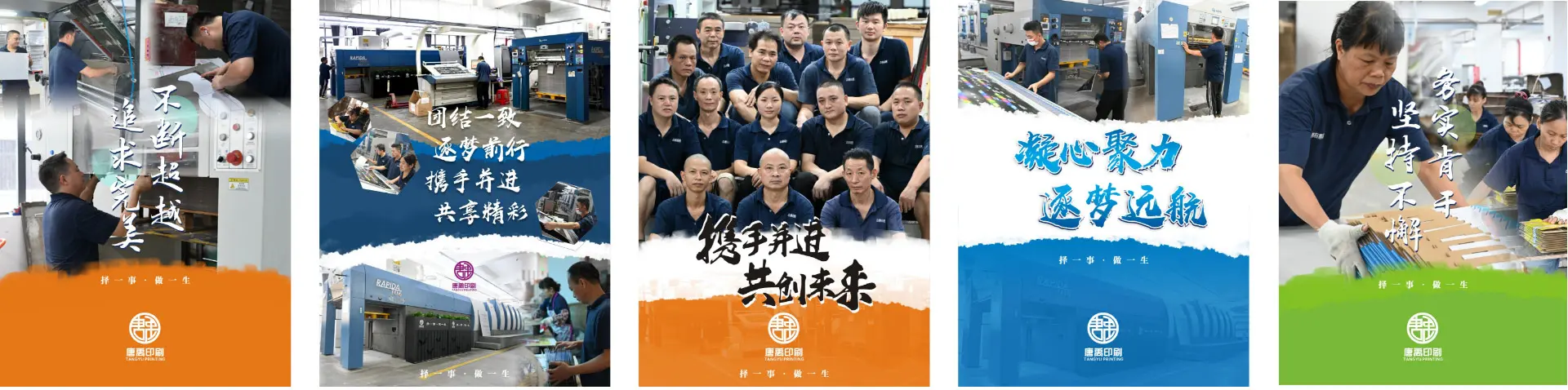
China's packaging manufacturing ecosystem, exemplified by hubs like Zhuhai, relies on automated high-capacity machinery to remain competitive globally. Utilizing state-of-the-art KBA and Heidelberg offset printing machines alongside automated high-speed corrugating lines, factories optimize paper utilization rates and reduce setup times.
For instance, at Zhuhai Doton Printing (established in 2009), advanced CTP (Computer-To-Plate) direct imaging systems bridge design artwork and actual printing plates seamlessly. This automation eliminates the human errors common in legacy screen-printing setups, assuring color consistency within a ΔE deviation threshold under 1.5. Post-print finishing, including automated die-cutting, film lamination, and window patching, ensures that production volumes exceeding one million units per month are consistently achieved without compromising on structural specifications.
Sourcing pizza boxes requires an understanding of the variables driving unit costs. Our 2025 pricelist framework reflects fluctuations in raw containerboard materials, freight charges, ink coverage parameters, and ordering volumes.
Our commitment to sustainable raw materials, advanced offset lithography, and high-efficiency logistics ensures product reliability.
Established in 2009, managing a comprehensive range of design, prepress preparation, printing, and distribution protocols for corporate global entities.
Equipped with KBA and Heidelberg offset presses to support ultra-precise color calibration, pantone reproduction, and spot UV accents.
Utilizing FSC-certified paper, recycled containerboard fibers, and VOC-free soy-based inks to align with European and North American green regulations.
Streamlined supply chain integration, from raw paper mills to shipping lines, ensures consistent container shipping costs and delivery schedules.
Fast turnaround on structural samples. Evaluate box strength, dimensions, and closures before embarking on production runs.
Over 1 million custom boxes manufactured monthly, supported by automated film laminators, die-cutters, and gluing setups.
Established in 2009, Zhuhai Doton Printing is one of the leading and professional manufacturers in China. We specialize in paper boxes, corrugated boxes, gift boxes, and paper shopping bags. Our packaging is widely used in the food, wine, cosmetic, jewelry, toy, and garment industries.
A key factor in our success in the global market is our focus on material research and development. We use FSC paper, recycled materials, soy ink, and environmentally friendly processes. To achieve high printing resolutions, we utilize advanced CTP systems to transfer artwork directly to plate. Printing is the core process of our packaging production, and we use brand new KBA printing machines to meet strict quality standards.
With a capacity of over one million boxes per month, we operate a full range of post-press machinery, most of which is fully automated. This includes film lamination machines, foil stamping machinery, die-cutting equipment, paper mounting setups, and automated box pasting units.

Industrial packaging must adapt to diverse operational environments. Selecting the correct liner density and flute profile depends on the target application:
To comply with global regulatory standards like CE, FDA, and EU food-contact standards, our corrugated packaging undergoes rigorous testing:
Expert answers regarding food safety certifications, manufacturing specifications, and international trade dynamics.
To achieve CE certification, packaging must comply with the material rules of Regulation (EC) No 1935/2004 (materials in contact with food) and European Directive 94/62/EC (heavy metals limits). The packaging must also be recyclable under the EN 13430 standard. Laboratory testing confirms that chemical migration is well within safe thresholds under high temperature and humidity.
Our engineering team designs custom-die cut tab vents in the side walls of the box. This configuration allows moisture and steam to escape, preventing the pizza crust from becoming soggy, while the corrugated air fluting (E-flute or B-flute) traps air pockets to insulate the box and keep the food warm.
For custom printed jobs using KBA offset lithography or high-speed flexo, our standard production run starts at 10,000 units. Smaller quantities can be accommodated depending on standard dimensions, but setting up custom-shaped dies and color-plate adjustments makes larger volumes more cost-efficient.
To prevent migration, we utilize a virgin kraft inner liner paperboard that serves as a functional barrier against the recycled components of the middle corrugating fluting. In addition, we print exclusively with low-odor, VOC-free soy inks and eco-friendly water-based adhesives.
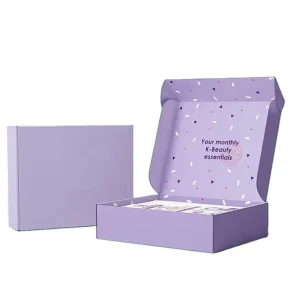
Browse our secondary industrial packaging items, customized shipping boxes, and rigid specialty gift containers.
 Doton Printing