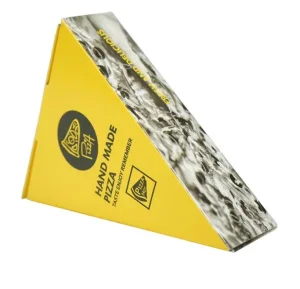
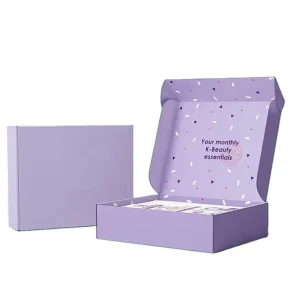
In the modern, highly regulated global food service industry, packaging has evolved from a simple containment vessel to a critical, multi-functional component of food safety, thermal management, and corporate brand positioning. In particular, the international pizza market requires packaging solutions that can withstand severe mechanical stresses while complying with complex international legal frameworks, most notably the European CE directive pathways for materials intended to come into contact with food (regulation EC No 1935/2004).
As global quick-service restaurant (QSR) chains optimize their supply chains to meet both environmental mandates and consumer safety standards, selecting certified manufacturers becomes an operational imperative. This whitepaper analyzes the structural engineering, safety certifications, manufacturing matrices, and cost drivers that define high-performance corrugated paper packaging, providing global procurement directors with the metrics required to make data-driven packaging decisions.

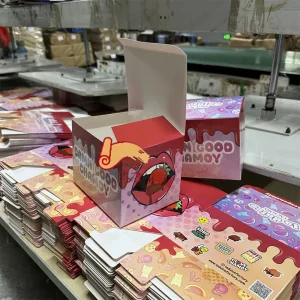
Established in 2009, Zhuhai Doton Printing Co., Ltd. has grown to become one of China's leading and most advanced professional packaging manufacturers. Spanning over 15 years of industry excellence, Doton has developed a highly integrated production ecosystem specializing in custom paper boxes, heavy-duty corrugated cartons, premium rigid gift packaging, and custom-printed retail bags. Serving food-contact, cosmetic, luxury apparel, and consumer electronic industries, the company provides end-to-end design, production, and logistics solutions.
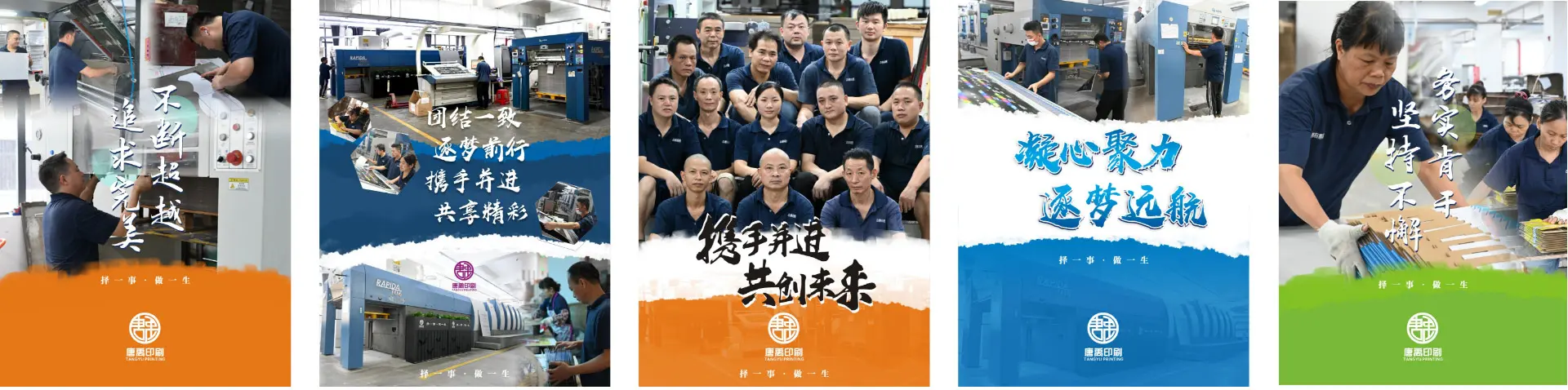
Doton’s market leadership is driven by a strong commitment to raw material integrity, advanced research, and high-performance equipment. The factory integrates Forest Stewardship Council (FSC) certified paper, premium recycled substrates, non-toxic soy-based inks, and food-grade barrier coatings. Utilizing automated Computer-to-Plate (CTP) prepress systems, artwork is direct-imaged to the aluminum plates, bypassing analog film steps to achieve higher printing resolutions. With a fleet of next-generation KBA offset presses and Heidelberg Speedmaster systems, Doton produces over one million units per month, supported by automated laminators, die-cutting, and box-pasting equipment.
In the European market, food packaging is governed by Regulation (EC) No 1935/2004, which establishes that materials coming into contact with food must not transfer their constituents to food in quantities that could endanger human health, bring about an unacceptable change in the composition of the food, or deteriorate its organoleptic properties. For paperboard and corrugated board, this requires strict monitoring of heavy metals, primary aromatic amines, formaldehyde, and organoleptic transfers.
We use biodegradable barrier coatings that prevent grease and moisture from weakening the paper fibers without the use of PFAS or synthetic fluorinated compounds.
Our corrugated board and virgin paper components undergo strict laboratory testing to ensure lead, cadmium, mercury, and chromium levels remain well below regulatory detection limits.
By using soy-based inks and water-based varnishes on our KBA Rapida presses, we reduce VOC emissions to trace levels, preventing any flavor transfer to the food.
A high-performance pizza box must balance heat retention with humidity escape. If a box traps too much moisture, the crust becomes soggy; if it vents too quickly, the temperature drops below the optimal serving range (60°C to 65°C) before delivery is complete.
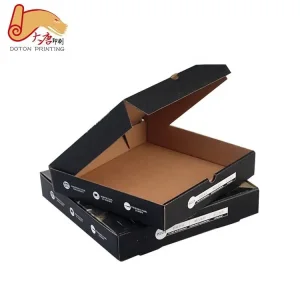
Doton addresses this dynamic through micro-flute configuration (primarily E-flute and F-flute corrugated profiles). The insulating property of corrugated paperboard relies on the air trapped within the fluting structure. E-flute, with a thickness of roughly 1.5mm and approximately 290 flutes per linear meter, provides excellent crush resistance and stack strength, while creating a reliable thermal barrier. Furthermore, the structural design incorporates strategic venting holes at the rear corners to allow steam escape without compromising structural integrity or heat retention.
Understanding the cost drivers behind corrugated packaging allows procurement teams to optimize their budgets. Price is determined by paper weight (GSM), fluting material, custom printing specifications, and order volume. Below is an industrial pricelist showing common configurations for CE-certified packaging.
| Box Dimensions (Inches) | Material Configuration | Printing / Treatment | Minimum Order Qty (MOQ) | Estimated Price Range (USD/Unit) | Certification Standards |
|---|---|---|---|---|---|
| 7" - 9" (Small / Personal) | 125g Kraft + 110g E-Flute + 125g Kraft | Flexographic / Water-based Ink (1-2 colors) | 10,000 units | $0.075 - $0.12 | CE, FSC, EC 1935/2004 |
| 10" - 12" (Medium / Standard) | 150g Kraft + 120g E-Flute + 150g Kraft | KBA Offset / High-Resolution (Full color) | 5,000 units | $0.14 - $0.22 | CE, FDA, ISO 9001 |
| 13" - 16" (Large / Family) | 175g Kraft + 130g E-Flute + 175g Kraft | Varnish Coating / Full Coverage Design | 5,000 units | $0.24 - $0.38 | CE, FSC, LFGB Compliant |
| 18" - 20" (X-Large / Commercial) | 200g Kraft + 140g B-Flute + 200g Kraft | Spot UV / Grease-resistant Coating | 3,000 units | $0.42 - $0.65 | CE, Food Contact Approved |
1. Raw Material Grade: Pure virgin kraft paper offers the highest tensile and tear strength, rendering it ideal for direct food contact. Testliner, which utilizes recycled fibers, is more cost-effective and is commonly used for the outer layer when direct contact is not required.
2. Structural Tooling: Custom shapes or built-in dividers require unique die-cutting plates. While these incur an initial tooling setup cost, they help lower labor costs on high-speed QSR assembly lines.
3. Print Technology: For basic branding, flexographic printing using water-based inks offers a cost-efficient solution. For premium packaging, offset printing using KBA or Heidelberg machines delivers sharp, photographic-quality imagery that enhances brand perception.
The packaging sector is shifting from standard cardboard structures toward circular economies and intelligent design. Future challenges, including localized plastic bans (such as EU-wide restrictions on single-use plastics), require quick-service restaurants to adopt plastic-free, fully compostable structural solutions.
Phasing out PE coatings in favor of water-based polymer dispersions, ensuring the box remains repulpable and fully biodegradable in normal municipal waste streams.
Establishing digital custody pathways that verify every batch of paperboard is sourced from sustainably managed woodlands, helping enterprise clients reach their net-zero goals.
Designing flat-pack structures with uniform crease resistance to prevent feeding jams on automated assembly lines, maximizing operational efficiency.
Shipping costs and warehouse storage represent major variables in QSR supply chains. Because empty, fully formed boxes are bulky to transport, we supply our packaging as pre-creased flat-packs.
By utilizing high-grade virgin kraft liners with high bursting strengths, Doton products resist edge crushing and bending during sea freight transit. This durability ensures that the boxes retain their structural integrity, shape, and food-contact properties even when stored in warehouses with high humidity.
Below are answers to the most common questions regarding food safety compliance, structural materials, and custom ordering processes.
 Doton Printing